
 EN
EN



How Massage Gun Reduces Delayed Onset Muscle Soreness After Workout
You push hard through a training session. It feels productive in the moment. But two mornings later, climbing stairs becomes an unexpected challenge — legs stiff, muscles heavy, each step carrying the weight of yesterday's effort. If that experience sounds familiar, you have encountered delayed onset muscle soreness firsthand. From a sports recovery standpoint, the core value of a massage gun is not simply comfort; it lies in whether the device can meaningfully accelerate the physiological process your muscles need to repair, reduce inflammation, and restore full function.
What Is Delayed Onset Muscle Soreness?
Delayed onset muscle soreness, or DOMS, is not just general fatigue. It is a specific physiological response that follows strenuous or unfamiliar physical exertion. Research consistently documents that DOMS develops within 12 to 24 hours after exercise, reaches peak intensity between 24 and 72 hours, and typically resolves within 7 days without intervention. The symptoms extend well beyond localized soreness: reduced muscle strength, limited range of motion, stiffness, localized swelling, and impaired joint function are all characteristic features of a significant DOMS episode.
DOMS is primarily triggered by eccentric contractions — movements in which the muscle lengthens under load, such as the descent phase of a squat or the lowering portion of a bench press. These contractions cause micro-trauma to muscle fibers, initiating a localized inflammatory cascade and oxidative stress response at the cellular level. The older theory attributing DOMS to lactic acid accumulation has largely been set aside by current research; the mechanism is structural, driven by micro-tears, the resulting inflammatory response, and the body's subsequent repair processes.
How a Massage Gun Targets the DOMS Cycle
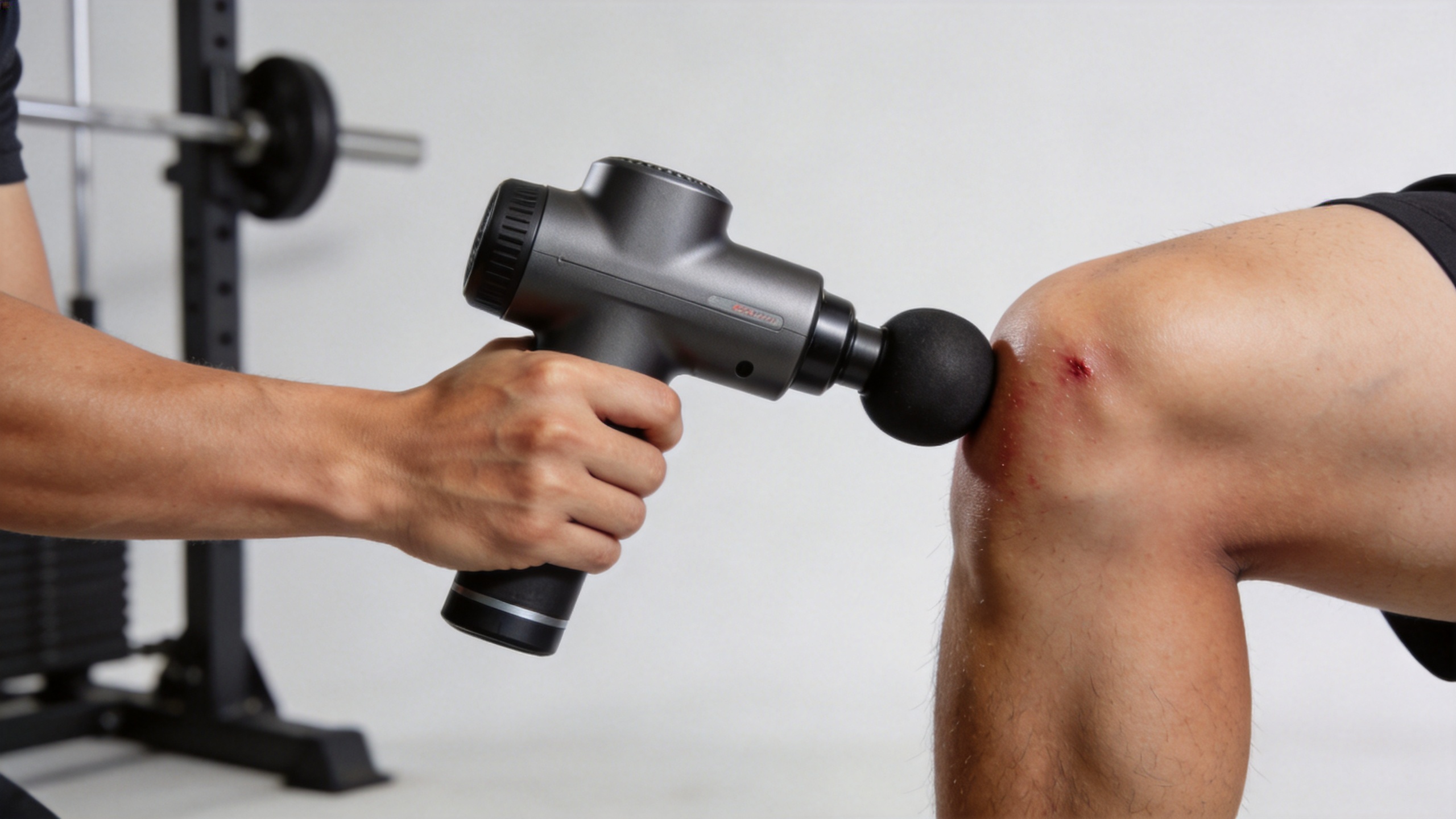
This is where percussion therapy becomes relevant. A quality massage gun delivers rapid, targeted mechanical pulses to soft tissue. When applied to DOMS-affected muscle groups, the high-frequency percussion mechanism creates several simultaneous effects that directly address the underlying biology of soreness:
- Increased local circulation: Percussive stimulation promotes blood flow to treated areas, accelerating oxygen delivery and the clearance of inflammatory metabolites, including the prostaglandins and cytokines that drive pain signaling during the DOMS window.
- Myofascial release and improved tissue elasticity: Muscle fibers and surrounding fascia that have tightened as a protective response to micro-damage can be mechanically mobilized through percussion. This helps restore tissue elasticity and reduces the stiffness that makes movement painful during active DOMS.
- Neuromuscular desensitization: The repetitive mechanical input from percussion may temporarily modulate pain signals through gate-control mechanisms in the nervous system, reducing the perceived intensity of soreness without interrupting the underlying repair process.
Research supports this mechanistic picture. A systematic literature review examining vibration-based therapies found that vibration interventions reduced DOMS at 24 hours, 48 hours, and 72 hours post-exercise. Notably, the greatest measurable effect was observed at the 48-hour mark, precisely when DOMS typically peaks in intensity. Comparative research has further shown that percussive massage accelerates recovery of muscle tone, stiffness, and elasticity significantly more effectively than passive rest alone. A well-designed deep tissue percussion massage gun is therefore not merely a comfort accessory — it is a functional tool with documented impact on the DOMS timeline.
When and How to Use a Massage Gun for DOMS Relief
The assumption that harder and longer means better results does not hold here, and understanding why changes how you will approach each recovery session. Here is a progressive breakdown of how to use a massage gun across the DOMS recovery arc:
Immediately After Intense Exercise
In the window right after a demanding workout, muscles are already under metabolic stress. Use the massage gun at a low to moderate intensity setting for 60 to 90 seconds per major muscle group. At this stage, the priority is gentle circulatory stimulation and early mobilization of fascia, not deep percussion. If your device has multiple speed settings, stay in the lower half of the range.
During the Peak DOMS Window (24 to 72 Hours)
Clinical guidance from physical therapists recommends using a lower intensity setting for up to 2 minutes per sore muscle group to provide meaningful temporary relief during the active DOMS period. The 48-hour mark is when research identifies the greatest potential benefit from vibration therapy. Consistent, moderate-intensity sessions targeting affected muscle groups across multiple days tend to outperform a single, intense treatment. This is a case where consistency across the DOMS episode matters more than any single aggressive session.
Before Returning to Training
Once acute soreness begins to subside, a 1 to 2 minute pre-session massage gun treatment on previously affected muscle groups can help restore range of motion and prepare connective tissue for loading. This is especially practical before returning to training with residual stiffness still present in the target muscles.
Managing Expectations: What Consistent Use Delivers
Here is something worth understanding from a recovery science perspective: the first session may not feel transformative. DOMS is a multi-day physiological process, and no single tool resolves it immediately. The meaningful benefits of consistent percussion therapy become more apparent over 2 to 4 days of regular use throughout a DOMS episode: faster restoration of mobility, a lower peak-soreness experience, and a quicker return to full training capacity.
For athletes and active individuals who train consistently across weeks and months, incorporating massage gun sessions as a regular post-workout protocol builds cumulative benefit. A single use after one hard session has a limited ceiling. Regular use across a training block — where DOMS is a recurring reality — is where the recovery advantage compounds.
Practical Application Guidelines
A few technique principles that apply whether you are using a massage gun for the first time or refining an existing recovery routine:
- Start at lower intensity settings: New users frequently apply maximum force immediately after hard training. This can increase discomfort rather than relieve it, particularly within the first 24 hours when tissue is most sensitized. Begin at the lowest setting and adjust from there based on how the tissue responds.
- Focus on muscle bellies, avoid joints and bone: The device is designed for soft tissue work. Bony prominences, joints, the spine, and any area with acute injury, bruising, or nerve sensitivity are not appropriate target zones.
- Keep sessions time-bounded: 60 to 120 seconds per muscle group is generally sufficient. Extended sessions past this range do not proportionally increase benefit once the circulatory and tissue-mobility response has been achieved.
- Device ergonomics affect consistency: A massage gun with a well-engineered handle significantly reduces user fatigue during self-massage, which matters most when targeting harder-to-reach areas like the mid-back or hamstrings. A device that requires awkward positioning or becomes uncomfortable to hold tends to be used less consistently. Consistent use across the DOMS episode drives recovery results, not occasional high-intensity sessions.
Choosing the Right Massage Gun for DOMS Recovery
For DOMS reduction specifically, the most relevant device specifications are amplitude and speed range. Amplitude determines how far the massage head travels per stroke, which governs whether percussion reaches deep muscle tissue or stays at the surface. Speed range determines whether you can match intensity to the phase of your recovery cycle. A massage gun that only operates at high percussive frequency offers limited control for therapeutic use. Multiple speed settings allow you to calibrate the treatment to what your muscles actually need at each stage of the DOMS window, from gentle post-workout mobilization to moderate mid-recovery sessions.
A compact, ergonomic form factor that allows self-application across all major muscle groups without assistance rounds out the practical requirements. For most users, a device meeting these criteria (adequate amplitude, adjustable speed range, and user-friendly handling) covers the functional requirements for post-workout DOMS management without unnecessary complexity.
DOMS is a predictable physiological response with a well-documented timeline. Percussion therapy, delivered through a quality massage gun with appropriate technique and timing, works by targeting several of the underlying mechanisms directly — not by masking discomfort, but by actively supporting the conditions that allow muscle tissue to recover faster. Used consistently and correctly, it represents one of the more practical and evidence-supported recovery tools available to athletes and active individuals alike.